

Displaced Person Stories
Explore the unforgettable testimonies of individuals who lived through the upheaval of World War II and its aftermath. These personal accounts, drawn from interviews conducted by Sarah Kavanaugh, bring to life the resilience, courage and humanity of survivors and their efforts to document, remember and make sense of their experiences. Their stories bear witness to both unimaginable loss and remarkable strength as they rebuilt their lives, rediscovered community, and forged new futures after the Holocaust.
These first-hand accounts provide historical context whilst preserving the perspectives of those who lived through this period.
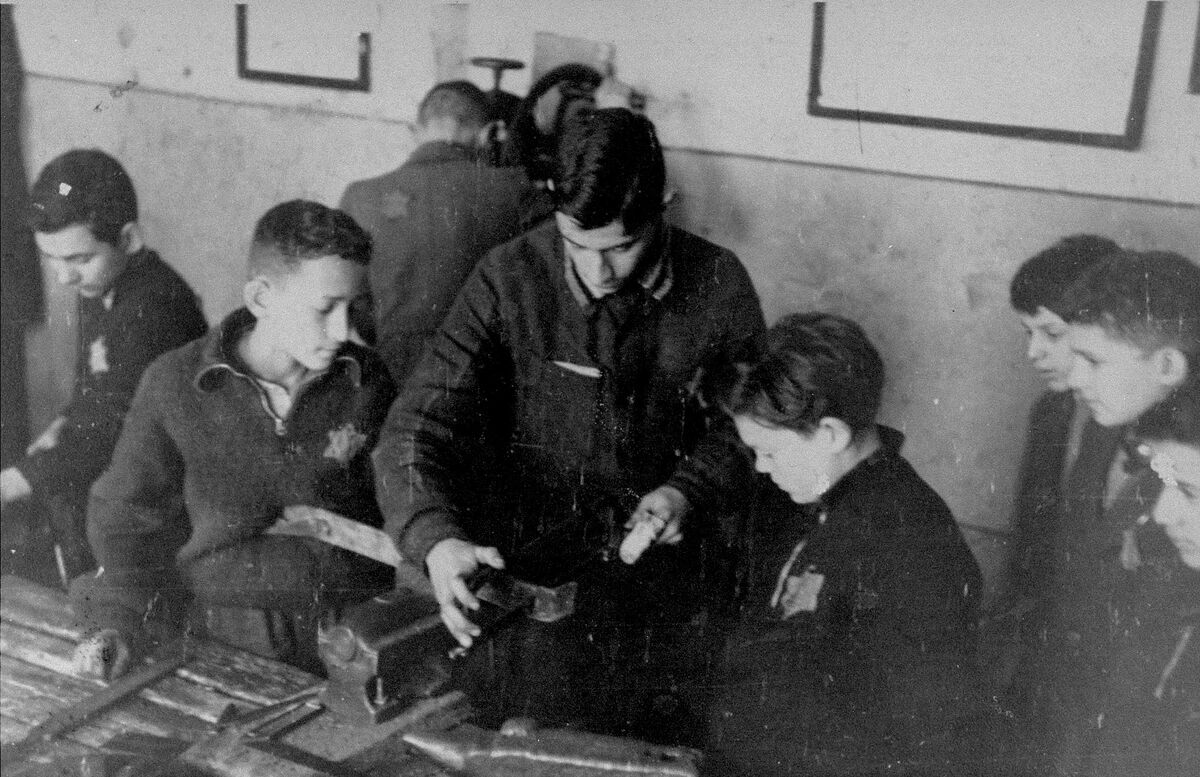
'We put on a play by Peretz, we discussed history and we played chess. As I look back now I must give credit to those dedicated and inspired teachers. Life in the Ghetto was miserable and the school was a place of respite. I was a good student...At the age of fifteen, I was a full instructor. That gained me permission to stay in the Ghetto, rather than having to go to work as a slave labourer at fifteen.'
Elly Gotz lived with his parents in Kovno in Lithuania. In 1941, after German army attacked the Soviet Union, the family was forced into the ghetto. He recalled: ‘The Aeltestenrat, Ghetto Management Group, requested permission from the Nazis to establish a training school in the Ghetto for kids twelve to fifteen, to train them for working later. When permission was granted they established a school, using the staff of the well-known ORT school in Kovno, as many of the teachers were in the Ghetto. Dr. Jacob Oleiski, who was the previous director of ORT Kovno, became the director of the school. I joined the Locksmith/Metal Work section. Our chief instructor was Yerachmiel Feldman, an experienced instructor of ORT before the war. I loved the experience! I learned first the tools of the trade, how to file, measure precisely and shape metal with hammer and chisel. Later we scrounged some machines, a lathe, mechanical drills, and I learned how to use them. Theory was taught in the afternoons, together with Jewish subjects. We put on a play by Peretz, we discussed history and we played chess. As I look back now I must give credit to those dedicated and inspired teachers. Life in the Ghetto was miserable and the school was a place of respite. I was a good student. After about eighteen months I was appointed an Assistant Instructor. Six months later, at the age of fifteen, I was a full instructor. That gained me permission to stay in the Ghetto, rather than having to go to work as a slave labourer at fifteen. I became particularly skilled at locksmithing, designing and producing sophisticated locking devices and elegant padlocks, some of which were taken away by the Nazi ghetto managers straight from the display boards we assembled for an exhibition of our work. I taught a morning and an afternoon class. I worked in the Ghetto Fachschule till the very end, when the Ghetto was liquidated and the remaining people were sent to Germany in cattle cars – the women to Stutthof and the men to Dachau Concentration Camp.’
In Dachau Elly Gotz survived due to his skills as a toolmaker. He got a job as a machine minder and for twelve hours a day (or night), looked after a huge concrete mixing machine. Even though most people in the camp died of hunger and disease, Elly and his father survived and were liberated in April 1945. As it turned out, Elly’s mother had survived again and the family could be together again.
‘After liberation from Dachau, I again began dreaming of becoming an engineer, but with little hope of achieving it. I had no formal schooling since the age of twelve, although I read and studied mathematics and other science on my own. I moved into a Displaced Persons (D.P.) camp in Landsberg-Am-Lech in Germany and I began to use my UNRRA rations to sell the coffee and chocolate on the black market and buy private lessons in mathematics, etc. One day, around December 1945, I walked past a sign advertising a new ORT school opening for teaching radio mechanics. Curious, I walked in and sat down in the class. It was the very first day the course was starting. A German lecturer came in (Mr.Albrecht) and began a general talk of how a radio works. I was fascinated! But I was planning to be a mechanical engineer, and this was electronics. Hesitatingly, I decided to come in next day to hear “The end” of the explanation of how wireless works. It was interesting! So after doubting and debating with myself for three days, I decided to stay in the course and I signed up. Every day it got more interesting! Mr. Albrecht was a very good teacher, challenging us to discover some new details by ourselves. Within one month I changed my plans: I was going to study electronics, if I ever got the chance. In the mean time I was a very good student, handy with the soldering iron and excited about the fact that everything that goes on inside a radio is all IMAGINATION – you cannot SEE anything, unlike a lock, where the logic is open to the eyes. After a few months of theory about all the elements of a radio we began to build our own radio from scratch – a Super-heterodyne Receiver, no less. Slowly we each assembled our own chassis, mounted the parts and were looking forward to the happy moment when our receiver will jump to life and produce a sound. Eventually all our radios began to work. We fine-tuned them, we fussed over them – we were all delighted. It was hard to find parts for building our radios – we had to search for parts, tubes and transformers, seek to buy them on the black market. Often one had obtained a transformer only to find that it was burnt out. I found a source of many burnt out transformers, so I decided to try and repair them. I built myself a small winding device, took the transformers apart, and unwound the fine wire till I came upon the burnt out spot. I rejoined the wire, rewound the transformer coil and reassembled it. Suddenly I had a lucrative market for transformers! That gave me funds to buy the other parts I needed. I located in Munich a source of parts and became something of a wholesaler of electronic parts.’- recalled Elly Gotz After twelve months of very energetic study he received his ORT diploma as a radio mechanic. In December 1946 the family decided to get out of Germany and went to Norway.
Elly Gotz learned Norwegian during the first six months and moved to the capital city – Oslo. ‘I went out looking for a job and soon found one as a radio mechanic. I began to study for the Norwegian High School Diploma at night school. My father found a relative in South Africa who invited us to come to Africa. Eventually we landed in Bulawayo, in Southern Rhodesia. Now I needed to learn English. I got into grade 12 in public school and 9 months later I passed the Cambridge exam and went off to University in Johannesburg, South Africa. For three months each summer I went home to Bulawayo and worked as a Radio Mechanic, which helped me pay for my education.I graduated as Electrical Engineer, Electronics. In 1958 I got married, had three children and in 1964 moved to Canada.’ [1]
[1] Source: World ORT Archive: Elly Gotz interviewed by Sarah Kavanaugh, March 2007
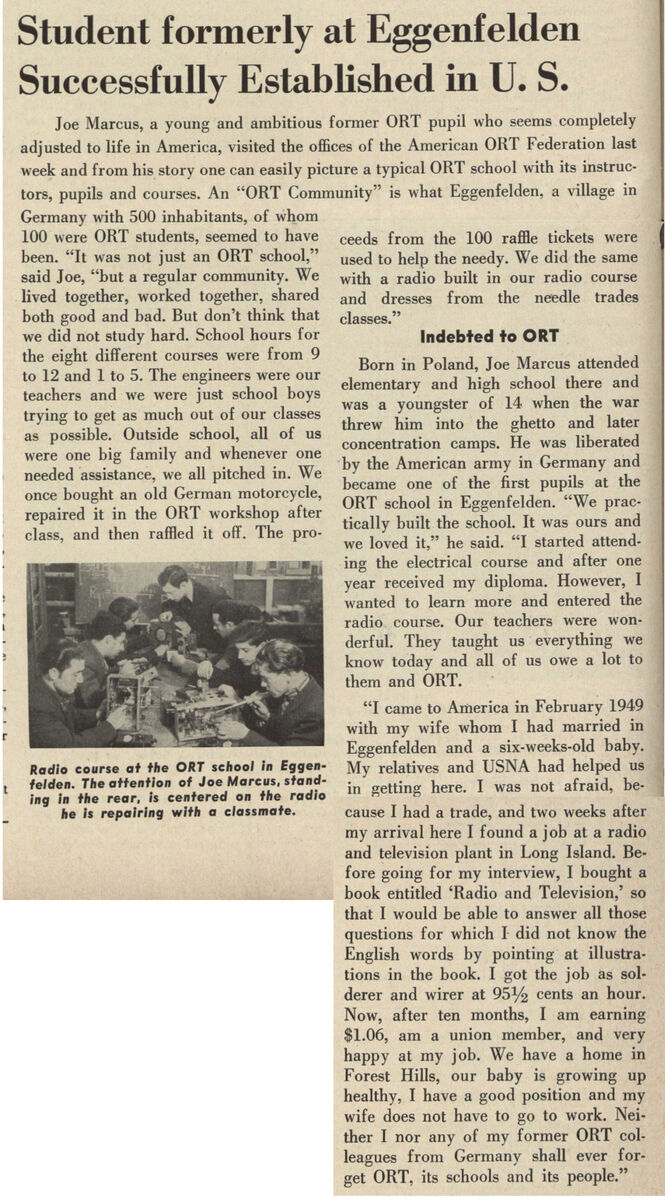
‘We practically built the school. It was ours and we loved it.'
Born in Poland, Joe Marcus was fourteen years old when the war threw him into the ghetto and later concentration camps. He was liberated by the American army in Germany and became one of the first pupils at the ORT school in Eggenfelden, a village with 500 inhabitants, of whom 100 were ORT students.
‘We practically built the school. It was ours and we loved it. It was not just an ORT school but a regular community. We lived together, worked together, shared both good and bad. But don’t think that we did not study hard. School hours for the eight different courses were from nine to midday and one to five. The engineers were our teachers and we were just school boys trying to get as much out of our classes as possible. Outside school, all of us were one big family and whenever one needed assistance, we all pitched in. We once bought an old German motorcycle, repaired it in the ORT workshop after class, and then raffled it off. The proceeds from the 100 raffle tickets were used to help the needy. We did the same with a radio built in our radio course and dresses form from the needle trade classes. I started attending the electrical course and after a year received my diploma. I came to America in February 1949 with my wife whom I had married in Eggenfelden and a six-week-old baby. I was not afraid, because I had a trade and two weeks after my arrival here I found a job at a radio and television plant in Long Island. Before going to my interview, I bought a book entitled ‘Radio and Television’. So that I would be able to answer all those questions for which I did not know the English words by pointing at illustrations in the book. I got the job.’
[1] Source: World ORT Archive: ORT Bulletin vol. III no.5 (January 1950), p.2
'Rehabilitation through training did more than skill training. It restored my self-respect, self-worth and above self reliance.'
Judy Cohen was born in the Hungarian town of Debrocen, the youngest of seven siblings in an Orthodox Jewish family. She was sixteen years old when the Germans entered Hungary. The Jewish community of her town was marked with yellow stars and forced into an overcrowded ghetto. Passover of 1944 was the last holiday that the family spent together. Within three months of the beginning of the occupation, in June 1944, her whole family was forced into a kettle truck and sent to Auschwitz. Three quarters of those who were in the same transport as Judy were murdered immediately upon arrival. Her parents and majority of relatives were among those killed. Judy survived Auschwitz, and then concentration camp in Bergen Belsen, a slave labor camp. She was liberated by the American army during a death march in May 1945. After liberation she travelled back to Hungary where she found that her youngest brother was still alive. Five months after liberation she heard from one of her sisters who was staying in the Bergen Belsen DP camp.
Judy and her brother embarked on a journey through the chaos of post war Europe, trying to get back to Germany and find her sister. They reached the camp and decided to stay there until they could get a visa to emigrate. In the camp Judy started attending an ORT vocational course in dental technology. ‘I quickly realized as I turned seventeen that I have no life skills and needed to learn something that I could earn my living with’ – she remembers. ‘Being in that ORT School was a great experience for me because rehabilitation through training did more than skill training. It restored my self-respect, self-worth and above self reliance. For us, Jewish Holocaust survivors, these aspects were doubly important to lessen the painful aftermath of our immensely devastating experiences in the Nazi Holocaust’- she recalled.[1]
In 1948 the siblings managed to obtain a visa to Canada as contracted needle workers. Judy settled down in Montreal, where she became a bookkeeper. She got married and had two children. After retiring she became an active Holocaust educator.
[1] Source: World ORT Archive: Judy Cohen interviewed by Katarzyna Person, April 2009
'In 1941, when I was eighteen years old, my father told me to leave home and escape to Russia to save myself. That was the last time I saw my family'
L. S. was born in Vilna in 1923. ‘My father was a builder of ovens in Vilna. By the way, he learned his trade in ORT too, recalled Sanders, ‘I followed in his footsteps. After seven years of elementary school, I went to the ORT school in Vilna- the Vilna Yiddishe Technicum- for four years. There I learned metallurgy and got an education’. During the Second World War, S. escaped into the Lithuanian woods where he joined the partisan anti-Nazi force.' In 1941, when I was eighteen years old, my father told me to leave home and escape to Russia to save myself. That was the last time I saw my family'- he recalled. As a member of the partisans, he was responsible for operating the radios, using the technical skills he gained in the Vilna Technicum. When the war ended he set out to search for his family. In a DP camp in Austria he met a girl who became his wife. On the day of their wedding found out that his sister had survived the Holocaust and was living in Milan. Senders and his wife went there immediately. In Milan L. S. enrolled into a course for repair of office equipment ran by ORT together with a typewriter repair company Olivetti. 'I was one of about fifty students, we learned how to operate office equipment and how to fix it. We had four hours of classes a day and the the language of instruction was Yiddish. I stayed in the school for a year'- he recalled. After graduation he and his family received visas to immigrate to the United States. They arrived in Washington DC on New Year’s day 1952. ‘The very next day I went downtown to find a job’-recalled S.-‘I walked into a typewriter company office right off the street, without an appointment, and asked if they could use a typewriter mechanic. I was hired on the spot’. Later, he set up a successful typewriter and office equipment company where he worked until his retirement. [1]
[1] Source: World ORT Archive: Syd Kasper ‘From Vilna to Washington’ (reprinted from ‘The Jewish Week’) ORT Bulletin vol. XXVII no.2 (Summer 1973), p.7 and interview by Katarzyna Person, May 2009
'On a day In early April of 1945 we were all ordered to get into formation and leave the camp by foot. We knew the Germans were close to defeat. As soon as the gates were opened four of us stepped out of line and started walking away. At this same time the guards started running away themselves. We soon found a burned out house and hid in the basement which fortunately for us was filled with burned potatoes from the fire. We lived on them for about ten days . We were liberated by the American Army on 17 April 1945.'
M.K. was a child, living with his parents and siblings in Dvinsk, Latvia when in June 1941 the German army invaded the city. He recalled: ‘ Within days of the German occupation of Dvinsk all Jewish men between eighteen and sixty, including my father, were ordered to report to the market square. Within a day or two they were all killed in the railway park behind the jail.’
By 15 July 1941, all remaining Jewish inhabitants were relocated to a newly created ghetto. The families were allowed to bring only what they could carry in their hands. There was no food, no furniture, no heat and the men and women (everyone over 14) were separated. The total population was estimated to be 23,048. The selections and killings started immediately. By 5 December 1941 the census showed 962 prisoners.
‘The final liquidation came on 1 May 1942, when both my siblings were killed. Everyone except those who were at forced labor outside the ghetto was killed. Only my mother and myself were left from our immediate family. After 1 May only about 487 prisoners remained alive. By the end of the war there were thirty-nine survivors of the Ghetto and a few hundred Jews who returned from Russia. ‘ recalled M.K. Following the final liquidation of the ghetto on 1 May 1942, all the remaining Jews were moved to the labour camp and after that to the Kaiserwald concentration camp. ‘By the fall of 1944, with the Russian army fast approaching, those of us who had managed to survive were placed on ships and sent across the Baltic Sea to Danzig and the death camp of Stutthof. I do know that my mother and I were together at Stutthof for some period of time but always separated by a barbed wire fence. I’m not sure how long I was in Stutthof but it was more than a few months. It was probably one of the most hostile environments and conditions of any of the concentration camps. Even the water was not fit to drink. At some point in mid-1944 I was in a group of 600 to 700 men selected to go by train to Magdeburg, not too far from Stutthof. I had to leave my mother behind and never saw her again. All those still alive in Stutthof in April of 1945 were sent out on a death march. I don’t have any record of the details or date of my mother’s death.’- wrote M.K.
He was liberated by the American Army on 17 April 1945. 'On a day In early April of 1945 we were all ordered to get into formation and leave the camp by foot. We knew the Germans were close to defeat and were confused as to what to do about the approaching Allies. As soon as the gates were opened four of us stepped out of line and started walking away. At this same time the guards started running away themselves. We soon found a burned out house and hid in the basement which fortunately for us was filled with burned potatoes from the fire. We lived on them for about ten days before liberation'- he recalled.
After liberation M.K.moved to a DP camp which was established in Feldafing and later to Weilheim.‘I took the ORT course to be a Medical Laboratory Technician, completing it on 11 November 1948. With the assistance of Hebrew Immigrant Aid Society over many months I made arrangements to leave Europe and go the US. I arrived in New York City in 7 May 1949. On the very same day I was put into a cab and taken to Grand Central Station and put on a train to Atlanta, Georgia. HIAS had given me 5.35 dollars for expenses for the trip but I met an older Jewish man on the train who spoke Yiddish and he very generously treated me to all my meals. So I arrived in Atlanta with the money still in my pocket: my first savings account. After arriving in the United States and being able to finish high school, I was lucky enough to get a job in a large hospital washing glass ware in their medical laboratory. I worked so that I could start my college studies. Many very helpful people started teaching me more and more, including many of the doctors and the Chief Pathologist and I was eventually hired to work in the lab in the evenings while I continued college during the day.’
M.K. graduated from the medical college and spent the rest of his professional life working as a successful doctor.[1]
[1] Source: World ORT Archive: MK interviewed by Katarzyna Person, May 2009
‘I got a lease on life. '
Miriam, was born in Buchara in Uzbekistan. She graduated from university in mathematics and physics and later married an American engineer who worked in Leningrad. During the war she and her husband and a son were evacuated to Alma Ata in Kazakhstan. Her husband was mobilized in a ‘labor battalion’ and she never heard from him again. One day she was informed that he had died in an accident.
In 1943 she was married again, this time to a Polish citizen. After the liberation the family was repatriated to Poland, but quickly fled it in an attempt to reach through Germany and Austria the promised land- Israel. After spending some time in a DP camp near Salzburg hunger and exhaustion attacked her husband’s health and that added to the effects of working in a Siberian mine caused tuberculosis and death.
Miriam also succumbed under the terrible strain of the endless struggle for survival. Only the will to survive in order to care for her young son prevented her from a complete nervous breakdown.
The rehabilitation centre in Ebelsberg took over. Doctors, nurses and psychiatrists examined her carefully and prescribed as part of the rehabilitation procedure ‘ a new interest in life; training for a manual vocation to prove to herself that she is capable to retraining her vitality’.
She had about twelve weeks of training in a needle trades course and was soon able to work for a full day. Her own feeling about her experience in Ebelsberg was in December 1949 best summed up by her own words: ‘I got a lease on life. I lived in debt to society. Very soon I am going to be a contributor to our people because for the first time I enjoy the opportunity of shaping my own future and that of my son.’ [1]
[1] Source: World ORT Archive: ORT Bulletin vol. III no.4 (December 1949), pp.5-6
At the age of fifteen Moshe returned to his home town to find that it had been ravaged by the war and there was no sign of the house he had known as his home, but a pile of rubble.
Moshe, a son of a tailor in a small town of Lukow, was only ten years old when the Second World War started in Poland. His family town of Lukow became a transit point for thousands of Jews from Poland and abroad transported to death camp in Treblinka. The Jewish community of Lukow was completely liquidated in May 1943.
Moshe’s family managed to leave the town before the mass murders began and leave for Russia. There, they spent the war. When after liberation of Poland the family returned to Lukow, they found no trace left of their former home. The family decided to leave Poland and move to a DP camp in Germany, in the Bamberg- Regensburg district, where they could await for emigration to Palestine and a new start in life.
In the camp Moshe. At that point aged sixteen, started quickly catching up on five years of lost school education. He also enrolled in an eight month vocational course in locksmiths training. In 1948 the family left for Israel. [1]
Mosze was born in Poland in 1918. Starting as a teenager, until the outbreak of the war he worked in Lodz, the second largest Jewish community in Poland, as a hosiery machine mechanic. After the Nazi invasion, he spent a year in the Gwozdziec ghetto in south-eastern Poland. With the rest of the ghetto population he was then transferred to the ghetto in Kolomyya and later a slave labour camp. He was liberated by the Russians in 1944 and then went on to live in the Soviet Union where he got married and had a child. From the Soviet Union, with his wife and child he went to Lower Silesia in Poland, a place of settlement of many Jewish repatriates from the USSR. From there he managed to illegally cross the border and reach a DP centre in the American zone of Germany. After an examination at the camp near Kassel he was diagnosed as tubercular. He stayed at the Oberkaufingen Sanatorium and after being discharged was sent to the Bayrisch Gmain Rehabilitation Center. In Bayerisch Gmain he started his apprenticeship in watch making since like many other DPs he found that his former trade was too much of a physical strain for him. Cured, and with a new trade, he later managed to emigrate to Israel.[1]
[1] Source: World ORT Archive: ORT Bulletin vol. III no.4 (December 1949) p.5
'After the liquidation of the Ghetto, together with my mother, sister and other members of my family I was deported to the extermination camp of Majdanek. We had no idea where we were being taken, we thought that we are being resettled to a better place with better conditions.'
Norman Frajman was born in 1929 in Warsaw. ‘My mother and her brothers and sisters attended the ORT school after going to regular schools. My grandmother insisted that all of her children learn a trade. She was very smart, we came from a well to do family and she foresaw the necessity that the offsprings should be prepared for life’- he recalled.
Norman Frajman was from an observant family and attended private, mostly Jewish school. However, his schooling ended when he was not even ten years old as in September 1939 the German troops entered Warsaw. In November 1940 the whole family was locked in the Warsaw ghetto- the largest ghetto in Europe, where over 400,000 Polish Jews were crowded in inhumane conditions. Tens of thousands of them died while still in the ghetto, of hunger and various diseases. After enduring the horrors of life in the ghetto, Norman Frajman’s family, like many others was deported to a death camp in Majdanek. 'After the liquidation of the Ghetto, together with my mother, sister and other members of my family I was deported to the extermination camp of Majdanek. We had no idea where we were being taken, we thought that we are being resettled to a better place with better conditions.'- he recalled. His mother and sisters were murdered and he, at the age of twelve, was sent alone to further camps in Skarzysko, Buchenwald and Schlieben. When he was liberated by the Russian Army during the death march in Germany on 8 May 1945, he was still only fifteen years old. After liberation Norman Frajman worked for a year as an interpreter from Russian to German. He then went to Berlin to the Schlachtensee DP camp followed by Bamberg in Bavaria, Neu Freimann and finally the Children's Emigration Centres in Landshut and Prien. In Prien he joined ORT course in photography. Soon after, he found an uncle who lived in the United States and in 1948 managed to emigrate. Though he never practiced the trade in a professional way, he remained a keen amateur photographer.’ I still have my graduating certificate which is a little worn to say the least. It certainly has been looked upon favourably by the US consulate making my emigration easier’- recalled Norman Frajman.[1]
[1] Source: World ORT Archive: Norman Frajman interviewed by Sarah Kavanaugh, January 2006
“We were Survivors. We were interested in studying and getting somewhere. We didn’t want to talk about the war. We were focused on the future.”
Robert Frimtzis was born in a town of Beltz in Bessarabia (now Moldowa). When he was ten years old his life was shattered when Germany attacked the Soviet Union and his town was destroyed. Together with his parents Robert Frimtzis evaded Nazi capture and escaped to Tajikistan. At twelve Robert had to quit school and go to full-time work to obtain food for his family, while his father served with the Soviet Union’s Red Army. After the war, the family fled the Soviet Union and crossing illegally many borders reached a DP camp in Cremona in Italy. “There was nothing to do in the camp,” he said. “Then, out of nowhere, we found ORT schools. They were a godsend. I’d never heard of ORT before that. The worst part of the DP camps was the boredom. So ORT provided us a way of getting out of the boredom. They offered courses in fields such as mechanics, electronics, radio repair and woodwork. I’d had to leave school at the age of twelve and work as a helper to an electrician so the electronics course at Cremona was an obvious choice.”
During his free time Mr.Frimtzis volunteered in the ORT office and pursued his own studies, using ORT text books – and with the support of ORT instructors – to learn algebra and physics. Later he attended a course in electrical motor winding run in a small refugee camp, housed in a nunnery outside the town of Iesi near Ancona.“We were Survivors. We were interested in studying and getting somewhere. We didn’t want to talk about the war. We were focused on the future.”- he recalled.
At the end of the course he was invited to apply for a place at the new Anieres Institute for training ORT Instructors. After entrance exams he was one of two people out of 400 applying from Italy to be accepted into the Central ORT Institute. The inaugural class consisted of sixty-three young men from various countries. They attended classes five days a week from morning to evening. “All the instruction was in French so we all had to study French. The instructors could speak various languages but once we were in the classroom it was only French. They told us it was for our own good. Imagine how difficult it is to study engineering – now try studying it in a language you don’t know. In addition you’re competing with some students whose mother tongue was French. But it only made us work harder. As far as I was concerned this was my road to the future”- remembered Mr.Frimtzis.
His studies at the ORT Institute were interrupted when he was granted a visa to go to America.
After arriving in the USA, Mr Frimtzis won a place at the City College of New York by gaining near perfect results in high school matriculation exams after studying only two semesters at night classes. Armed with a bachelor’s degree in electrical engineering, he went on to gain a Masters degree at Columbia University and joined the historic Apollo programme which put man on the Moon.[1]
[1] Source: World ORT Archive: Robert Frimtzis interviewed by Katarzyna Person, June 2009
"There was no-one from my family to search for at the war’s end"
S.G. was born in Tarnow in South-East Poland, a town with a thriving Jewish community of 35,000. In September 1939 the city came under the German occupation and soon after the whole Jewish community of Tarnow was placed in a closed ghetto. In subsequent deportations the Jews of Tarnow were sent to death camps or murdered in the vicinity of the town. When he was fourteen years old, S.G.’s parents were murdered in the crematoria of the death camp at Belzec. He himself managed to avoid death.
In the following two years until he was sixteen years old, he underwent a harrowing journey through Krakow Plaszow, Gross Rosen and Falkenberg concentration camps, a death march towards Mauthausen concentration camp and finally Ebansee concentration camp, where he was liberated by the American army. After liberation S.G. spent a while recovering in a hospital, soon after however he was on his way again. He was transported to Italy, where he went through a number of DP camps to finally settle in Barletta in September 1947. 'I there was no-one from my family to search for at the war’s end'- he recalled.
Thanks partly to his command of English, which enabled him to liaise with the British military administration; S.G. was appointed secretary for the ORT schools in his camps. Eventually, aged only 18, he was running the whole ORT operation in Barletta as Acting Director, overseeing over 300 students enrolled in the school. He even found time to do one of its courses, agronomy, which had been hurriedly introduced to allow Jews to acquire skills as farm workers which would then qualify them for a visa to America. In 1949, G. finally received his visa to America and made his way to California to join his fiancée, whom he had met in the Italian DP camp. [1]
[1] Source: World ORT Archive: S.G. interviewed by Katarzyna Person, June 2009
"We did a lot of good work in the camps."
Sol Berger was twenty years old when Nazi army invaded south eastern Poland. On 9 August 1942 the liquidation of the Jewish community of his home town of Krosno began. Salomon's father was in the first group of 500 people sent to death. Later his mother and sister were gassed. Salomon and his brothers -- Moishe, Michael and Joshua – were taken into forced labor crews in the area. But his mother and remaining sister were still in Poland. Both were taken in cattle cars to the death camp Belzec and gassed. A month later, the Gestapo took away Michael and Moishe. Soon after, with help of false identity papers, Salomon managed to escape the ghetto. The day later all of its inhabitants were killed. Assuming a Christian identity Salomon joined a Polish work brigade, later he managed to get through to Polish partisans and joined them in fighting the Germans. In March 1944, he was forced into the Russian army. When the war ended Salomon decided to leave Poland. He joined the group illegally crossing the border to Czechoslovakia. Then, via Hungary and Romania he reached a displaced persons camp in Italy. Salomon spent three years, between 1945 and 1948, in a displaced persons camp- first in a transit camp in Bari and later in Barletta, where he worked as ORT teacher, teaching design. Each class he taught contained fifteen to twenty students and he spent two days a week teaching in Bari and two days in Barletta. His was paid thirty US dollars a month and received free lodging in former Italian military barracks. 'We did a lot of good work in the camps'- he recalled later. He later managed to join his younger brother Michael who after surviving Auschwitz immigrated to the US. In the camp Salomon’s son Jack was born. After three years in a camp and two years in London, Samuel finally reached United States. He settled in Los Angeles. It was not until he was fifty-seven when he could finally enrol into college. He graduated in business and later became a successful real estate agent.
In 1994, when his brother was dying of cancer, he asked Salomon to start talking about his survival and the Holocaust. Since then he started sharing his story.[1]
[1] Source: World ORT Archive: Sol Berger interviewed by Katarzyna Person, June 2009
Uri Urmacher was born in 1935 in the town of Siedlce, in eastern Poland.
"My family consisted of my father, who was a optic lense maker and photographer, my mother, a homemaker, and my younger sister, Ruth. My paternal and maternal grandparents owned properties and businesses, in nearby in Biala Podlaska, Poland, and I had numerous aunts, uncles, and cousins, on both sides of my family. Everyone perished, except for my father, sister and I.
Of Siedlce’s 30,000 inhabitants, around fifty percent were Jewish, working professionals in the arts, theatre culture, business and government positions - many held political offices. They financially supported, and funded public rail travel, secular hospital and schools, libraries and museums.
Our families had lived in this part of Poland for hundreds of years, and men in each and every generation served in the Polish army and infantry, during Europe’s multiple wars.
My paternal grandfather was a professor at the Warsaw University who spoke six languages, and taught Esperanto, among other subjects. He was a specialist in optic lenses, had the first movie studio and theatre in Warsaw, and would have been considered a “Renaissance Man” by the standards of the times," recalled Mr. Urmacher.
The family spent the war hiding in Poland, trying to make their way to Russia. When Uri Urmacher was five years old, his mother died, and he was placed together with his sister in an orphanage run by Jewish partisans. The children survived the war hiding in forests.
After the war, with help of former survivors of the Warsaw Ghetto uprising, they were smuggled across the borders of many war torn European countries to a displaced persons camp in Rosenheim, Germany. It was here that they were to wait a further journey to what was to become, The State of Israel.
It was in Rosenheim, Germany, that Uri Urmacher lived in an orphanage, and was trained in an ORT machine shop. "While waiting for transportation to Israel, ORT took us in hand, and began to teach us how to make metal parts, tools, ice-skates, and the likes. The basics of tool and machine making. We were given materials, assigned tasks, and our work critiqued. We were provided warm clothing, shoes, boots, and special holiday gifts," he fondly remembered.
From Rosenheim, Uri Urmacher together with other orphaned children embarked to Israel on board the ‘Exodus 1947’, memorialized in a book by the same name, by author Ruth Gruber. The historic journey of The Exodus became the symbol of the struggle of Holocaust survivors in post war Europe. Amidst wide media coverage, and despite international protests, the ship was stopped on the way by the British Royal Navy. In the fight which emerged during taking over of the ship, a crew member, and two children were killed, and many others injured. All of the passengers were deported by the British back to camps in Germany.
Finally reaching Israel, Uri Urmacher continued his education while living in a kibbutz. In 1961, he met and married American born Glenda Eiss, and settled with his wife in Long Island, New York, and became a successful engineer.
Source: World ORT Archive: Uri Urmacher interviewed by Katarzyna Person, March 2009
'We walked barefoot and in rags out of the woods when we heard the Russians had come back. We caught a lift on a lorry into our city, where our former neighbours were amazed that we were still alive and were not particularly happy to see us return.'
William Tannenzapf was born in Stanislawow in south-eastern Poland in 1911.
He came from a modern religious family and as a youngster played an active part in the community and belonged to youth organisations. Due to problems with anti-Semitism at Polish universities, he went to study engineering in Prague in Czechoslovakia. During the war the part of Poland where he lived was occupied by the Soviet army. When the Nazis invaded the city in 1941, all of its Jewish inhabitants were moved into the ghetto and the vast majority of them later murdered. William Tannenzapf managed to escape with his wife and a baby daughter just before the liquidation of the ghetto. They spent the rest of the war in hiding - first in a nearby village and later in the woods. Describing the moment of liberation, Mr. Tannenzapf recalled: 'We walked barefoot and in rags out of the woods when we heard the Russians had come back. We caught a lift on a lorry into our city, where our former neighbours were amazed that we were still alive and were not particularly happy to see us return.'[1] The family fled Poland and moved to a DP camp in Eggenfelden in Germany. In Eggenfelden Mr.Tannenzapf started by helping organize a school for Jewish children. He recalls, 'I was aware of the housing problem but like several other like-minded residents, felt that that an even more tragic situation was the condition of the young camp population who were growing into illiteracy. There were no schools!' As soon as the opening of the school was announced, the children rushed into it. I was teaching mathematics."
In the meantime, he also realized that much of the camp population, remnants of Holocaust survivors, had no skills for gaining useful employment. He decided to do something about it. ' I contacted the district leaders of the UNRRA-supported ORT trade school system and got full support for opening a school in Eggenfelden, with myself as designated principal.'
He organised courses in tailoring, machine knitting, upholstery, auto repair, electrical, home construction, machine weaving, morse code/communication, and machine shop.
'I worked for ORT because I wanted to make a contribution to the young people for the same reason I helped to establish the school for children and taught there. I also wanted to help people to re-establish their lives by gaining useful skills and productive employment.'- recalled William Tannenzapf. Before leaving Germany, William Tannenzapf was also appointed as Director of the ORT school in Pocking, the largest ORT school in that district, which had been running into problems.
The family stayed in Eggenfelden until the camp was almost closed. As they had no relatives left in Europe, in November 1948 they went to Montreal in Canada, where Mr. Tannenzapf worked as an engineer and continued teaching at evening and weekend ORT courses. The family subsequently moved to Hamilton, Ontario, where Mr. and Mrs. Tannenzapf lived for 47 years.
Source: World ORT Archive: William Tannenzapf interviewed by Sarah Kavanaugh, December 2005
"The ORT school in Hamburg was not just a school, but the center of Jewish life where the older people got together in the evenings and the young ones gathered during the day to learn trades; where the Jewish people were brought together for an Oneg Shabat; were social functions were held; and were everyone felt that he belonged."
Wilma was born in 1931 in Hamburg, Germany,
In 1943, when she was twelve years old and attending school, her mother was taken away to do forced labor and her father left for Bolivia. Wilma had to take all kinds of jobs, ranging from household work to selling in order to earn her living. All attempts on the part of mother and daughter to join the father in Bolivia were unsuccessful, so they remained in Germany through the war years.
In 1947, when ORT classes became available in Hamburg. Wilma's mother enrolled in a dressmaking class while teenage Wilma registered for the course in commercial art.
‘Our teacher at ORT was a well known Berlin illustrator who gave us practical instruction instead of empty theory. The ORT school in Hamburg was not just a school, but the centre of Jewish life where the older people got together in the evenings and the young ones gathered during the day to learn trades; where the Jewish people were brought together for an Oneg Shabat; were social functions were held; and were everyone felt that he belonged’- she recalled
Wilma and her mother came to New York in 1950. After arrival Wilma on the basis of her ORT diploma found a job as a silk screen designer continued her studies as a fashion designer. [1]
[1] Source: World ORT Archive: ORT Bulletin vol. III no.6 (February 1950) p.2
"When the Germans entered, we ran to the forests and then after much time, dangers and hardships, we wound up in Siberia where life too was a constant struggle and trial."
Zelda Fuksman was born in an observant Jewish family in a village of Bobel, Poland. She was four years old when the Second World War started. The part of Poland where she lived was initially occupied by Soviet army. It was invaded by the Nazis in 1941, when Zelda Fuksman was six years old. Very few of the Jewish community in her town survived the war. She herself spent the war in hiding, first in forests and later in Siberia. After the end of the war the family returned in cattle cars to their pre war home. However upon returning to Poland they encountered such severe ant-semitism that they decided to move illegally to DP camps in Germany. They were first in the DP Camp Neu Ulm and then were able to transfer to Stuttgart, where she started attending ORT classes. ‘In Stuttgart I started school and after school we attended sewing classes. We had no sewing machines so every stitch was done by hand. We were also taught the fine embroidery stitches. I was a good student and was hungry to learn. I was eleven, twelve, thirteen years old in those days’- she recalled. Her brother attended classes in mathematics and auto mechanics. The family stayed in Stuttgart until it closed and were later transferred to other transit camps, waiting for the visa. They arrived in Chicago, Illinois in 1949, when Ms. Fuksman was thirteen years old and reunited with their American family. ‘I have learned that I can do just about anything. The wonderful sewing that I learned at ORT served me well throughout my life. I did not continue with a sewing job, but continued with education in the USA and did other work, but the fine sewing, has developed in me a patience and desire to continue with many handicraft projects, such as needlepoint, crocheting, knitting, sewing.’ [1]
[1] Source: World ORT Archive: Zelda Fuksman interviewed by Sarah Kavanaugh, June 2006